
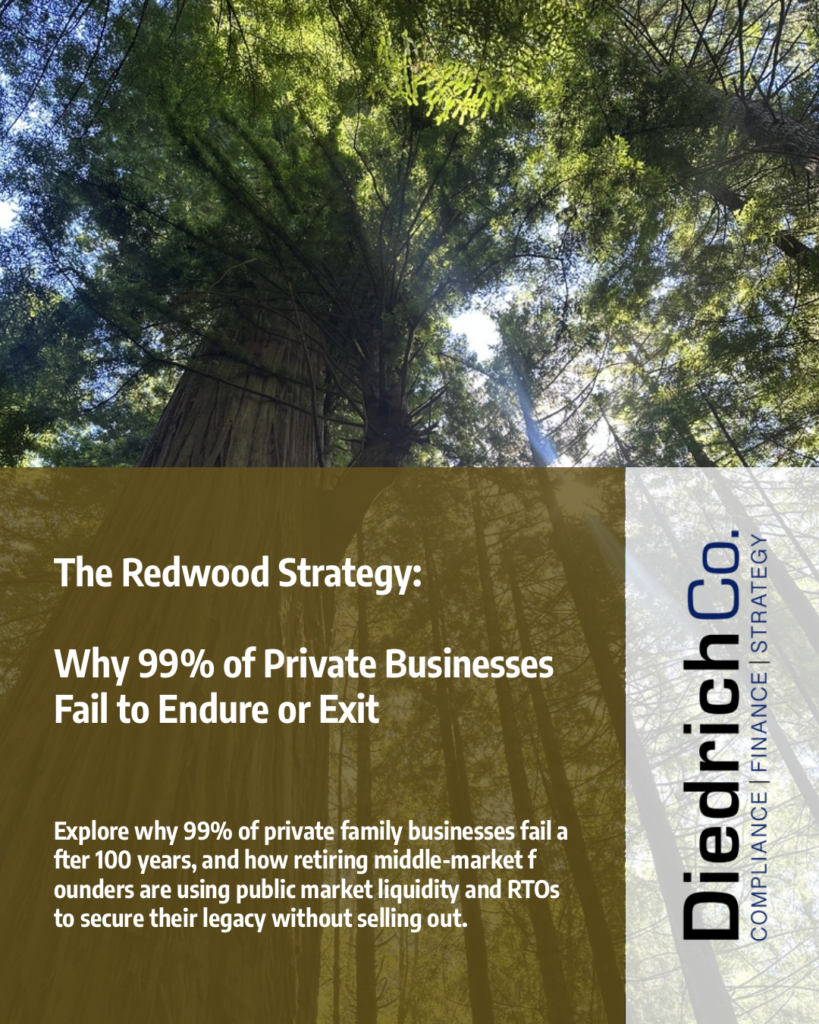
A century from today, nearly every private middle-market business will have vanished. For the retiring founder, avoiding the PE buyout and transitioning to the public markets is the ultimate structural defense for generational wealth.
Across the American corporate landscape, an unprecedented intergenerational wealth transfer is unfolding. Yet, for the elite lower-middle-market (LMM) founder staring down retirement, the traditional “exit strategy” presents a painful paradox. You spent decades building a highly defensible, cash-flowing asset. The operational foundation is pristine. The enterprise value is undeniable. But as you look toward the next generation, traditional advisory models push you toward a singular, binary event: the complete liquidation of your life’s work to private equity or a strategic competitor.
For the high-conviction founder, surrendering the asset for a standard 6x to 8x EBITDA multiple feels less like a victory and more like a structural surrender. You know the intrinsic value of your enterprise. You know that a one-time buyout check can never replace the enduring security and compounding power of owning a dominant, cash-flowing asset. The next generation may not want to manage the daily operations, but they certainly want the wealth it generates.
The question for the modern boardroom is no longer how to sell out. The question is how to create operational permanence. To understand how to achieve this, management must look to the foundation of the coastal redwood (I recently took a trip through Northern California).
The Taproot vs. The Grove: The Anatomy of Corporate Longevity
Coastal redwoods are the tallest, most resilient living structures on earth, easily living for over two millennia. Their survival defies logic: despite growing over 300 feet tall, they have no deep taproot. Instead, their roots plunge only a few feet into the soil before extending outward, aggressively intertwining with the roots of the surrounding grove. If a massive storm hits, the entire forest holds the individual tree upright.
By contrast, the traditional LMM private business operates like a solitary oak tree relying on a single, massive taproot: the founder.
When the founder steps back, the taproot is severed, and the structural integrity of the enterprise collapses. The statistics surrounding this phenomenon are devastating. According to legacy data from the Family Business Institute and institutional research, roughly 30% of family businesses survive into the second generation, 12% to the third, and a mere 3% make it to the fourth.
Zoom out to a 100-year timeline, and the mortality rate of the private family-owned business approaches an astonishing 99%.
Why do they fail? Not because the product loses relevance, but because the capital structure is fundamentally fragile. When wealth transfers in a private, illiquid vehicle, disputes over valuation, estate taxes, and non-active family members demanding buyouts inevitably fracture the company. The asset is dismantled to pay for its own succession.
Compare this to the enduring permanence of public companies. Public entities routinely outlive their founders by a century or more. Why? Because the public markets act as the interlocking root system of the redwood grove. By transitioning to an SEC-reporting, exchange-traded environment, the company’s survival is no longer tethered to a single individual. It is supported by an institutional framework of corporate governance, perpetual capital access, and most importantly, liquid equity.
Engineering the Sovereign Exit
For the retiring founder who refuses to take an “illiquidity discount” on their valuation, transitioning the enterprise to the public markets—whether via a highly structured Reverse Takeover (RTO) into a pristine NASDAQ vehicle or a Direct Listing—represents the ultimate strategic pivot.
You do not have to sell out to step back.
By taking the company public, you convert your illiquid private shares into a high-velocity, institutional-grade currency. This unlocks a vast scope of opportunity that the private markets simply cannot match:
1. The Public Equity Premium Private markets punish founders with the “illiquidity discount.” Public markets reward them with a liquidity premium. By entering the public equities arena, your company benefits from multiple expansion. A private asset trading at a 7x multiple can rapidly command a 12x to 15x multiple in the public markets simply due to enhanced price discovery, institutional visibility, and real-time liquidity.
2. Absolute Sovereignty & Control Unlike a private equity buyout that installs draconian debt covenants and strips your boardroom of its autonomy, a strategic public transition allows you to retain a controlling interest. You maintain voting power, dictate the strategic direction of the board, and protect the cultural legacy of your enterprise, all while inviting the benefits of institutional capital.
3. Frictionless Generational Succession When your equity is digitized, DTC-eligible, and publicly traded, succession planning ceases to be a crisis. If one heir wishes to cash out to buy real estate, they simply liquidate their shares on the open market. If another wishes to hold the stock for dividend yield and long-term appreciation, they do so without burdening the company’s balance sheet. The interlocking root system of the public market absorbs the transaction, leaving the underlying operating asset entirely untouched and fully capitalized.
Command Your Enterprise Value
The era of defaulting to a business broker or submitting to the rigid terms of a middle-market buyout fund is over. The most sophisticated founders are realizing that their businesses are not just operations—they are sovereign assets structurally primed for the public stage.
At DiedrichCo we align complex corporate finance functions with institutional public market expectations. We provide the blueprint required to secure premium liquidity, defend your valuation, and ensure your enterprise endures for centuries to come.