

An unprecedented transfer of corporate wealth is under way across the private middle market. As thousands of founders and principal owners evaluate exit strategies, the volume of private enterprises brought to market has reached historic highs. Yet, market data across the M&A landscape reveals a striking discrepancy: the vast majority of businesses that list for sale never complete a transaction.
This high failure rate does not reflect a shortage of global capital. Private equity dry powder remains near record levels, family offices are actively pursuing direct operating acquisitions, and strategic buyers continue to seek accretive growth. Instead, the breakdown occurs long before a transaction reaches the closing table—stemming from structural deficiencies in financial reporting, unsupportable valuation metrics, and transactional approaches that fail to meet institutional underwriting requirements.
The Data Behind the Failure Rate
Data from leading exit planning and M&A research organizations demonstrates that transaction completion is directly linked to business scale, governance, and financial preparation:
- The Macro Failure Rate: Research from the Exit Planning Institute’s (EPI) State of Owner Readiness study indicates that 70% to 80% of privately held businesses brought to market fail to execute a transaction.
- Open Market Listing Metrics: Aggregate tracking data from platforms such as BizBuySell shows that only 20% to 22% of active listings close a transaction within a standard 12- to 18-month window.
- Completion Rates by EBITDA Tier: Market pulse data published jointly by the International Business Brokers Association (IBBA) and M&A Source confirms that completion rates correlate tightly with enterprise size and financial rigor:
- Under $500,000 EBITDA: Failure rates reach 85% to 90% (a 10% to 15% execution rate), reflecting high owner dependency and informal financial tracking.
- $500,000 to $3 Million EBITDA: Failure rates hover between 70% and 80%, where businesses often lack formal Quality of Earnings (QoE) reporting.
- Above $3 Million EBITDA: Failure rates drop to 40% to 50% as enterprises attract institutional buyers, dedicated deal teams, and professional underwriting standards.
Root Causes of Private Market Deal Collapse
When a middle-market business fails to trade, the underlying enterprise is rarely without operational merit. More often, the listing collapses under the weight of predictable, preventable issues during the deal cycle.
1. Indefensible Valuations
Many sell-side mandates are built on subjective expectations, arbitrary industry multiples, or legacy performance rather than forward-looking, risk-adjusted cash flows. When an un-defended valuation is presented to institutional buyers, it creates an immediate credibility gap. Professional capital underwrites strictly on verifiable, repeatable earnings.
2. Diligence Breakdown and Quality of Earnings (QoE) Deficits
A business may demonstrate strong top-line revenue, but if its accounting framework cannot withstand forensic scrutiny, buyers will re-trade the price or walk away entirely. Incomplete revenue recognition under ASC 606, unadjusted owner expenses, messy working capital calculations, and weak internal controls frequently surface during buy-side accounting diligence—causing up to a third of signed Letters of Intent (LOIs) to terminate prior to closing.
3. Key-Person Dependency
When an enterprise’s primary client relationships, vendor networks, or strategic operational workflows reside exclusively with the founder, institutional acquirers view the asset as fundamentally unstable. Lacking an autonomous operational structure or key performance indicator (KPI) accountability across mid-level management, the business incurs steep key-person discounts or restrictive earn-out requirements that undermine deal viability.
4. The Structural Advisory Gap
Private business owners are typically presented with two traditional transaction paths, both of which carry inherent limitations:
- The Business Brokerage Model: Standard business brokers primarily target lower-EBITDA businesses using passive public listing networks. They issue generic financial teasers, lack the infrastructure to produce institutional Quality of Earnings reports, and rely heavily on local buyers dependent on traditional debt financing.
- The Traditional Investment Bank: Mid-tier investment banks typically reserve their senior resources for larger mandates. When handling middle-market companies, they often apply rigid, single-track sell-side playbooks designed exclusively for standard private equity buyouts—forcing sellers into restrictive terms, large escrow retentions, or valuation haircuts.
Structuring Assets for Maximum Market Value
DiedrichCo approaches transaction readiness through financial engineering rather than passive marketing. Rather than listing an asset on an open board, the firm prepares, structures, and positions enterprise assets to achieve top-tier liquid valuations prior to engaging buyers.
1. Defended Valuations Built on Forensic KPI Analysis
The process begins by isolating and optimizing the core Key Performance Indicators (KPIs) that institutional investors prioritize: customer acquisition economics, net expansion rates, recurring revenue stability, gross margin durability, and executive succession structures. Quantifying and stress-testing these metrics prior to market entry creates a mathematical framework that justifies premium valuations to investment committees.
2. Institutional Financial Communications & Bulletproof QoE
To prevent diligence fatigue and price re-trades, DiedrichCo establishes an institutional-grade Quality of Earnings (QoE) framework early in the process. Aligning management discussion and analysis (MD&A), GAAP compliance standards, and revenue modeling into a clear disclosure package presents financial communications “through the lens of management,” eliminating buy-side friction and preserving transaction momentum.
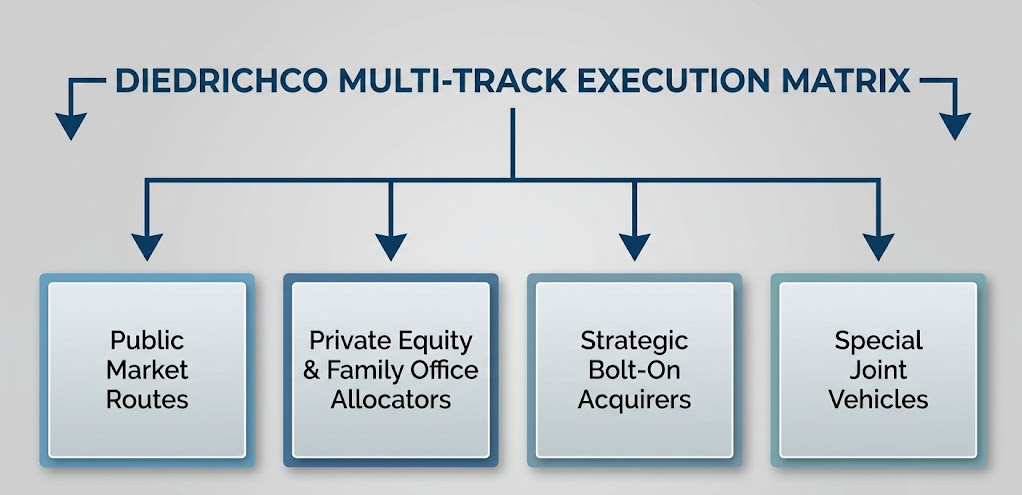
3. Broadening the Buyer Spectrum via Multi-Track Structuring
Instead of relying on a single exit path, DiedrichCo designs a multi-track liquidity framework engineered to generate genuine competitive tension across multiple capital tiers:
- Public Market Access Structures: For growth-oriented middle-market assets, a traditional private buyout is not the only option. Alternative paths to public liquidity—including Reverse Takeovers (RTOs) into clean public vehicles, direct listings, and SEC-registered business combinations—transform illiquid private stock into a liquid acquisition currency.
- Curated Private Equity & Family Office Capital: Direct engagement with institutional private equity sponsors and patient family office capital identifies platform buyers willing to structure terms that preserve operating culture while maximizing cash at close.
- Strategic Middle-Market Bolt-On Acquirers: Targeting well-capitalized industry operators seeking accretive bolt-on acquisitions allows sellers to capture higher multiples driven by immediate cost synergies and multiple arbitrage.
- Special Joint Venture (JV) Vehicles & Structured Recapitalizations: For owners seeking partial liquidity while retaining upside, tailored JV vehicles and equity recapitalizations allow founders to extract substantial capital today while positioning the enterprise for a second liquidity event downstream.
Engineering Successful Transaction Outcomes
The middle market presents unprecedented liquidity opportunities, but entering the market without rigorous preparation carries substantial execution risk. Unprepared listings frequently lead to stalled negotiations, extended deal timelines, and significant value erosion.
Achieving a top-tier exit is the result of disciplined financial engineering, rigorous earnings defense, and flexible transaction structuring. By aligning internal KPIs, fortifying financial disclosures, and evaluating alternative liquidity avenues across public and private domains, business owners can reliably bridge the liquidity gap and secure the full value of their enterprise.
To evaluate your company’s transaction readiness or schedule a confidential advisory consultation, contact DiedrichCo today.