
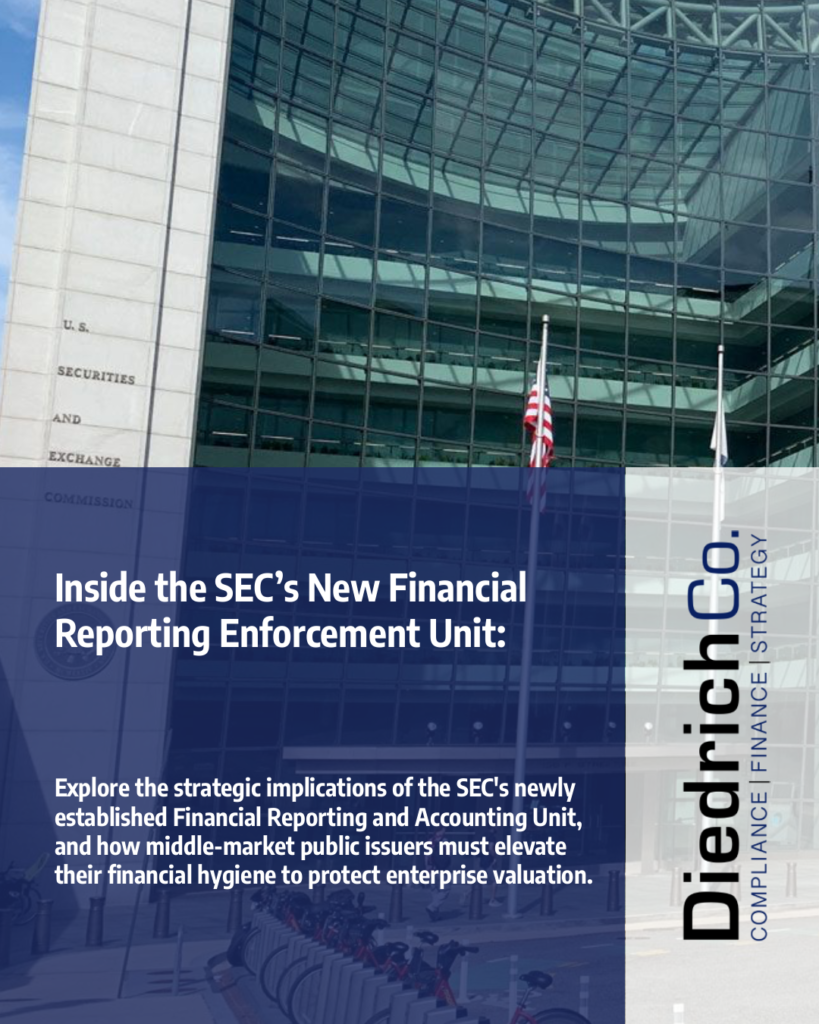
With the creation of a specialized Financial Reporting and Accounting Unit, the SEC is signaling an end to the era of regulatory leniency—demanding pristine financial hygiene from middle-market boardrooms.
The era of generalized regulatory oversight is officially over. On August 5, 2026, the Securities and Exchange Commission executed a structural shift that will fundamentally alter the risk calculus for public boardrooms: the establishment of a dedicated Financial Reporting and Accounting Unit within its Division of Enforcement.
For the small cap issuer, this announcement is the equivalent of a regulatory warning shot. The SEC is no longer relying on generalist investigators to parse complex corporate disclosures. Instead, they are deploying a highly specialized strike force of attorneys and forensic accountants specifically mandated to pursue financial reporting discrepancies and auditor misconduct.
The Structure of Enforcement
Under the direction of David Woodcock, Director of the SEC’s Division of Enforcement, the agency has spent 2026 meticulously realigning its tactical resources. The new unit, helmed by Timothy Zimmerman—a veteran of international corporate law and former Deputy General Counsel at a global accounting firm—is designed to dismantle the operational opacity that has historically plagued the lower and middle markets.
As Principal Deputy Director Osman Nawaz indicated, the deployment of this unit brings a “depth of experience” specifically calibrated for the granular mechanics of securities regulation. This elite group of regulators is not simply looking for blatant, headline-grabbing fraud. They are hunting for aggressive revenue recognition tactics, misaligned Critical Accounting Estimates (CAEs), weak internal controls, and the subtle engineering of non-GAAP metrics designed to obscure true operational health.
The Small Cap Vulnerability
Why does this matter to the transaction-ready enterprise, the De-SPAC merger, or the newly minted public issuer? Because in the modern capital paradigm, pristine financial hygiene is the ultimate corporate currency.
Many middle-market boards mistakenly view SEC compliance as a static, back-office administrative task. In reality, a fragmented financial infrastructure is a severe structural vulnerability. When the Financial Reporting and Accounting Unit initiates an inquiry, the resulting friction doesn’t just trigger legal fees—it fundamentally degrades your enterprise valuation. A specialized enforcement action, or even a protracted comment letter phase regarding your Management’s Discussion and Analysis (MD&A), can permanently fracture institutional credibility, paralyze M&A pipelines, and suppress liquidity.
Designed Defense
Be structurally impenetrable. Boardrooms can no longer afford to rely on principles-light reporting or generic audit preparation. To thrive under this new enforcement regime, your financial architecture must be engineered to withstand the scrutiny of specialized forensic auditors long before a filing reaches the public domain.
At DiedrichCo, we operate as the definitive execution layer for leadership teams navigating these high-stakes public markets. By aligning complex corporate finance functions with Wall Street’s expectations and the SEC’s strict enforcement, we ensure your financial communications serve as a catalyst for premium valuation, rather than a vector for risk.
Command your value. Do not leave your capital structure exposed to the SEC’s newest enforcement protocol.