
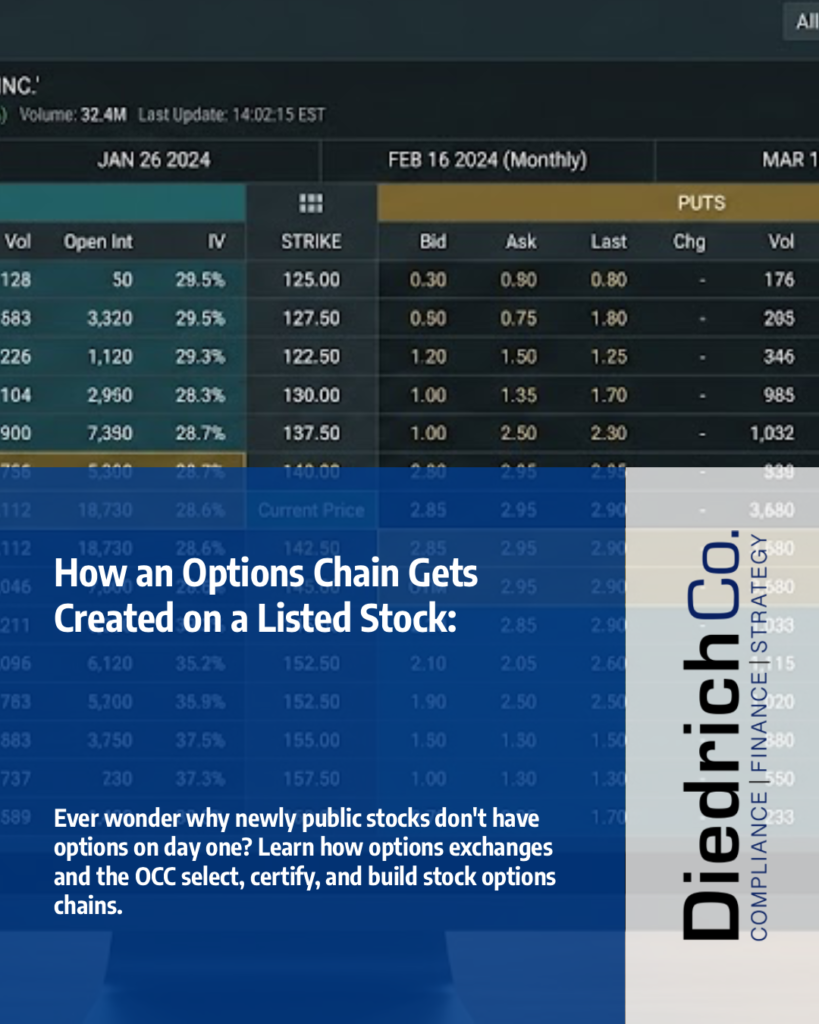
What actually happens when a Nasdaq- or NYSE-listed company becomes “optionable”
When a company lists on Nasdaq or the NYSE, its common stock may begin trading immediately, but an options chain does not automatically appear alongside it. In the U.S., listed equity options are created through a separate market-structure process involving the options exchanges, The Options Clearing Corporation (OCC), and the market-data network that distributes options quotes and trades. In other words, the stock issuer does not simply “turn on” an options chain. An options exchange decides to list options on that stock, certifies the class to OCC, and then opens the individual series that investors ultimately see as the options chain.
That distinction matters. A company can be fully listed and actively traded on Nasdaq or NYSE, yet still have no listed options. Each U.S. options market selects the underlying interests on which options are traded, and options with the same standardized terms may trade on more than one options exchange at the same time. OCC, meanwhile, stands in the middle as the central clearinghouse for every listed-options trade in the U.S.
Step one: the stock has to be eligible for listed options
Before an options chain exists, the underlying stock must satisfy exchange eligibility standards. Current exchange rules require, at a minimum, that the security be an NMS stock, widely held, and actively traded. Cboe’s rulebook, for example, includes guidelines calling for at least 7,000,000 publicly held shares, at least 2,000 holders, and at least 2,400,000 shares of trading volume over the preceding 12 months. For covered securities, the market price generally must have been at least $3.00 for the previous three consecutive business days before the exchange submits its certification to OCC.
That is why not every listed company has listed options, and why newly public companies often do not have options on day one. OCC’s educational guidance summarizes the same point plainly: the stock must meet float, holder, price, and trading-market requirements before an exchange makes the business decision to list options on it.
Step two: an options exchange selects the class
Once a stock is eligible, the process typically begins with an options exchange such as Cboe, Nasdaq ISE, Nasdaq PHLX, NYSE American Options, or NYSE Arca Options deciding that it wants to trade options on that underlying. Under the Options Listing Procedures Plan, a registered options exchange that wants to begin trading options on an equity security must notify OCC by submitting a certificate during a specified window on the trading day before it wants to start trading that option class. If the certificate is timely and valid, the selecting exchange may begin trading the class on the next trading day.
This is the core answer to the question, “Who creates the options chain?” In practice, the initial chain is born when an exchange selects the stock as an underlying option class and certifies that listing to OCC under the national market system plan. The issuer does not file a separate “options application” with Nasdaq or NYSE to make that happen. The options market infrastructure handles it.
Step three: the exchange opens specific option series
After the option class is approved, the exchange opens actual series for trading. A class is the overall option on the stock. The chain investors see is made up of many series: calls and puts, different strike prices, and different expiration dates. Nasdaq ISE’s rules state that after a class is approved, the exchange may open series in that class and, before trading begins in any given series, it fixes the type of option, expiration month, year, and exercise price. At commencement, the exchange opens at least one series, with the initial strike set relative to the stock’s price in the primary market around the time trading begins.
This is what turns a theoretical option listing into a visible chain on a broker screen. The first strikes are usually centered around the then-current stock price, and then additional strikes and expirations are added as trading interest develops and as exchange rules permit.
Step four: more strikes and expirations get added over time
An options chain is not static. Once a class is live, exchanges can add new series intraday or for the following session, subject to notice procedures with OCC and the other options exchanges. Under the Options Listing Procedures Plan, same-day add-on series generally require notice to OCC within 10 minutes of commencing trading, while series intended for the next day or later generally must be noticed by 4:15 p.m. Chicago time. New expiration months follow their own notice schedule.
That is why option chains expand as a stock gains volume, price movement, and trader interest. Weeklies, monthlies, quarterlies, and other short-dated expirations are not all necessarily present on day one. Exchanges open them as the class matures and as rule-based product programs allow. Nasdaq ISE’s rules, for example, allow short-term series for designated classes, including Tuesday, Wednesday, Thursday, and Friday expirations under the applicable program rules.
Step five: strike spacing is governed by exchange programs
Many investors assume strike prices are generated automatically by software, but the reality is more structured. Exchange rules and industry programs determine how finely strikes can be spaced. One major example is the Penny Interval Program, under which certain multiply listed options can trade with tighter strike intervals and penny pricing conventions. NYSE states that newly listed option classes may be added to the program if they rank among the most actively traded multiply listed option classes by OCC-cleared volume after launch.
So, when a company first gets options, its initial chain may be relatively simple. Over time, if activity builds, more strikes may appear closer together, weekly expirations may populate more densely, and the chain starts to look like the liquid, fully built-out options board investors associate with larger-cap names.
Step six: OCC clears it, and OPRA publishes it
Once the class and its series are listed, the options are standardized and cleared through OCC. OCC explains that most listed options have standardized terms, and options having the same standardized terms are identical and comprise an options series. That standardization is what allows multiple exchanges to trade the same option series and still have a centralized clearing framework.
From there, the market-data side kicks in. OPRA — the Options Price Reporting Authority — disseminates consolidated last-sale and quotation information from the national securities exchanges approved to trade exchange-listed options. In plain English, OPRA is one of the reasons a trader can open a brokerage platform and see a unified options chain, rather than having to piece together separate quotes exchange by exchange.
What Nasdaq, NYSE, and Cboe each actually do here
This is where many people get tripped up. Nasdaq and NYSE as stock listing venues are not the same thing as the options exchanges that list and trade standardized options. A company may be listed on Nasdaq or NYSE on the equity side, while options on that stock are listed and traded on one or more separate options exchanges, including Cboe, Nasdaq’s options markets, and NYSE’s options markets. The underlying stock’s primary listing helps establish the security as an NMS stock and provides the reference market price, but the options chain itself is created within the listed-options ecosystem.
So when market participants say, “Nasdaq options opened on this name,” they often mean that a Nasdaq-operated options exchange began trading standardized OCC-cleared options on a stock that may itself be listed on Nasdaq or NYSE. Likewise, Cboe and NYSE options venues can list and trade options on stocks regardless of whether the underlying common stock is primary-listed on a different national exchange, provided the class meets the applicable rules.
Why this matters for public companies
From a corporate strategy standpoint, becoming optionable can be meaningful. A listed options market can expand visibility, improve hedging utility for institutional holders, and sometimes deepen the ecosystem of liquidity around a stock. But it also comes with more sophisticated trading behavior around the name, including hedging flows, volatility trading, and event-driven positioning. Whether that is beneficial depends on the issuer’s shareholder base, trading profile, and broader capital markets strategy. The key point is that options availability is not cosmetic — it reflects the stock’s integration into a deeper layer of public market infrastructure.
The bottom line
An options chain is created in stages. First, the stock must meet eligibility standards. Then an options exchange selects the stock as an underlying option class and certifies it to OCC. After that, the exchange opens specific series — calls and puts, strikes and expirations — and may add more series over time. OCC standardizes and clears those contracts, and OPRA distributes the consolidated quotes and trades that investors recognize as the live options chain.
For issuers, advisors, and investors alike, the practical takeaway is simple: a listed stock does not automatically have options just because it trades on Nasdaq or NYSE. An options chain is a separate market-structure product, built by the options exchanges and clearing infrastructure around the stock once the underlying satisfies the right standards.