
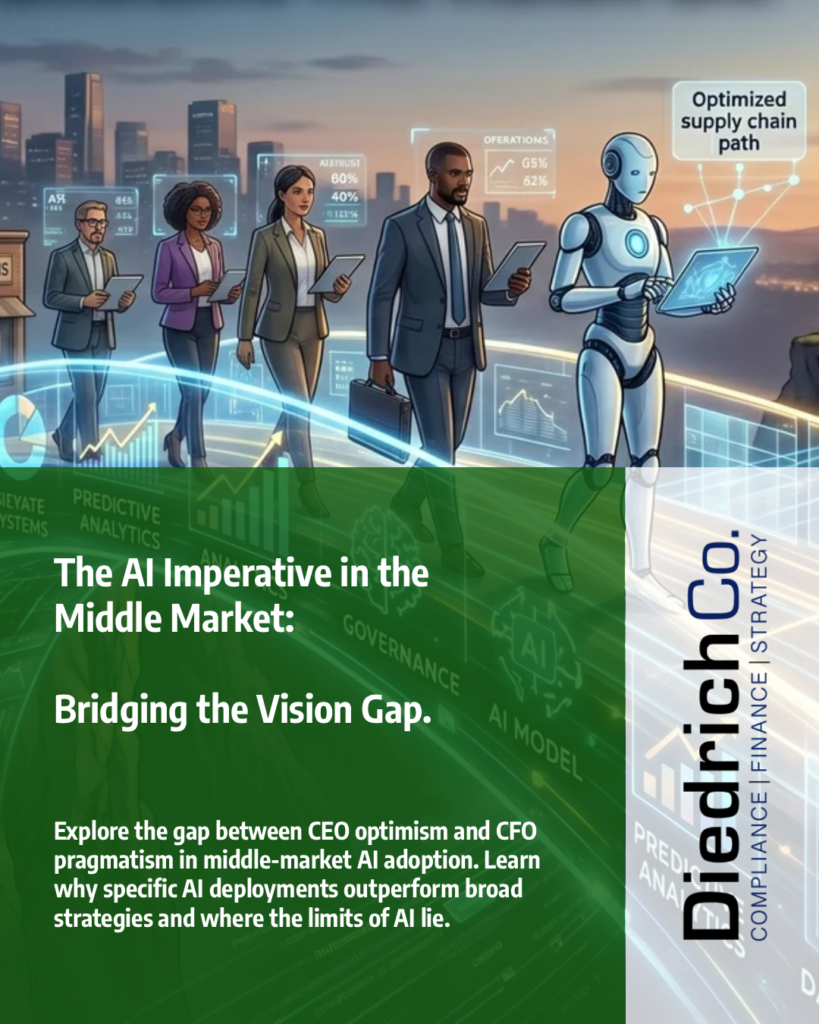
In the 2026 landscape or the “experimental” phase if you will of Artificial Intelligence (AI) has officially concluded with a bang!
For middle-market companies, AI has transitioned from a boardroom buzzword to a core pillar of operational strategy.
However, as adoption accelerates, a distinct “vision gap” has emerged between the optimistic CEO and the pragmatic financial leader. Understanding the nuance of where AI adds value—and where it falls short—is now the primary challenge for the C-suite.
1. The CEO Perspective: AI as a Growth Engine
For most middle-market CEOs, AI is viewed through the lens of competitive survival and exponential growth. Current data indicates that 65% of CEOs rank accelerating AI as a top-three priority, with many doubling their investment year-over-year.
Where CEOs see the benefit:
- Agentic Productivity: The rise of autonomous AI agents is shifting workflows from human-led processes to outcome-driven automation.
- Market Dominance: CEOs are using AI to radically rebuild operations, systematizing the expertise of top performers into scalable digital assets.
- Valuation Premium: There is a growing belief that AI proficiency will redefine industry leadership, making “AI-optimized” companies more attractive to Private Equity (PE) and M&A buyers.
2. The Financial Leader Perspective: The ROI Reality Check
While CEOs are leaning into a “Trailblazer” mindset, CFOs and financial leaders often occupy a “Pragmatist” middle ground. While 61% of midsize CFOs agree that AI has streamlined financial processes, there remains a healthy skepticism regarding realized returns.
Where Financial Leaders see the benefit:
- Fraud & Risk Mitigation: AI-powered tools for real-time transaction monitoring and cybersecurity remain the highest-impact use cases for finance teams.
- Efficiency in FP&A: Financial Planning and Analysis (FP&A) has been revolutionized by AI’s ability to spot patterns in vast data sets, enabling scenario planning that was previously too labor-intensive.
Where Financial Leaders remain cautious:
- The ROI Gap: While 97% of executives have deployed AI agents, only 29% report significant ROI. Financial leaders are wary of “performative AI”—initiatives that look good in a pitch deck but fail to move the needle on the P&L.
- Governance & Trust: Finance teams require “explainability.” An AI model that produces a confident forecast without a traceable logic path is a liability in a controlled audit environment.
3. The Reality of Deployment: Specificity Over Scope
The most critical lesson of the last 24 months is that not all AI is created equal. A broad “AI strategy” is often less effective than three specific, narrow deployments.
Middle-market companies often find that:
- Specificity Wins: A bespoke model trained on a company’s internal proprietary data is exponentially more valuable than a generic wrapper around a large language model.
- Data Integrity is the Bottleneck: AI is a “garbage in, garbage out” system. Companies with unorganized legacy data will find that AI adoption actually increases technical debt rather than reducing it.
- AI Cannot Replace Human Judgment: AI is excellent at synthesis and pattern recognition, but it lacks the context for ethical nuance, strategic “gut” feeling, and complex relationship management.
Basically, Navigating the Limits of the Machine
As we move further into 2026, the middle-market imperative is to move past the “AI can do anything” hype cycle. AI is a tool of immense power, but it is not a panacea. It cannot fix a broken business model, and it cannot replace the core narrative of a company.
Success lies in recognizing that AI is most effective when it is deployed to solve a highly specific operational friction point. The value is found not in the technology itself, but in the precision of its application. For the modern leader, the goal is to identify the narrow, high-impact intersections where machine speed can truly enhance human strategy—while remaining grounded in the reality that the most complex business problems still require a human at the helm.
At Diedrich Consulting, we help leaders navigate these technological shifts to ensure they are positioned for long-term growth and market readiness.