
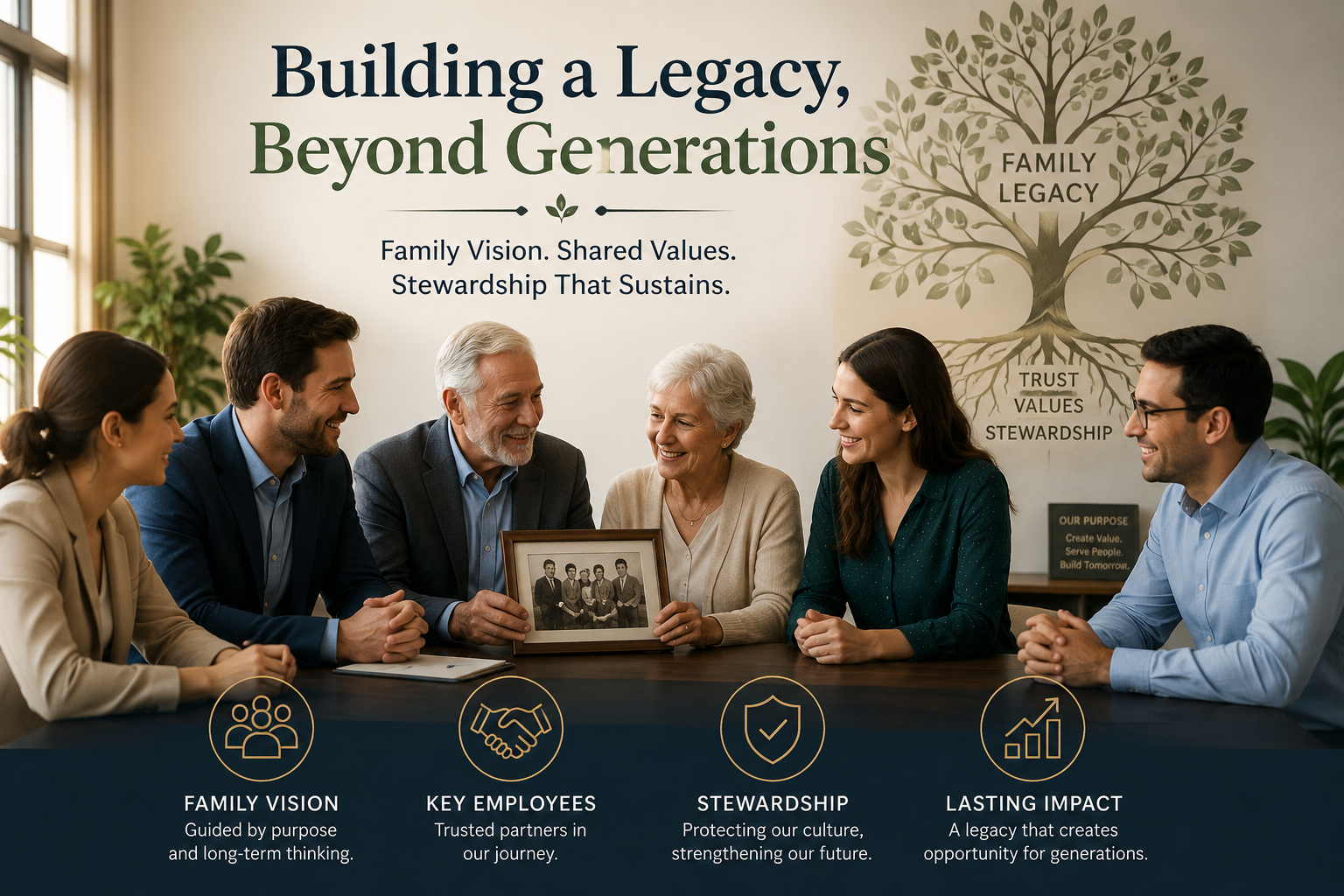
Building a Business That Outlives You: Liquidity, Legacy, and the Future of Founder-Led Family Enterprises
For many founder-led businesses, the company is more than an asset.
It is a family name.
It is decades of risk.
It is employees who stayed through the hard years.
It is customers who became relationships.
It is a town, a region, a trade, a brand, and a way of doing business that cannot be recreated on a spreadsheet.
Yet many successful family-owned and middle market businesses eventually face the same uncomfortable question:
What happens when the founder is ready to step back, but the business is not ready to slow down?
For some companies, the answer becomes a sale to private equity or a strategic buyer. In the right circumstances, that can be a strong outcome. But for many founders, that path carries a deeper fear: that the life’s work they built will be absorbed, restructured, stripped for parts, consolidated, or sold again to the highest bidder.
The founder may receive liquidity, but the legacy may not survive.
At Diedrich Consulting, we believe there is another way to think about liquidity.
Not simply as an exit.
Not simply as a sale.
But as a strategy to preserve the enterprise, provide for family shareholders, reward key employees, and position the company to grow for generations.
The Hard Truth About Family Business Continuity
Family businesses are some of the most important enterprises in the economy, but long-term continuity is difficult.
A commonly cited family business statistic says that roughly 30% of family businesses transition to the second generation, 10–15% reach the third generation, and only 3–5% reach the fourth generation. Researchers have debated how universally that statistic should be applied, but the broader point remains clear: generational transition is hard, and survival is not automatic.
Cornell’s family business resources similarly cite that only a minority of U.S. family-owned businesses successfully pass into later generations, with far fewer reaching the fourth generation or beyond.
That should concern any founder who wants the company to outlive them.
Most family enterprises do not fail because the founder lacked passion. They fail because passion alone is not a succession plan.
They fail because ownership becomes fragmented.
They fail because inactive family shareholders need liquidity.
They fail because the next generation has different goals.
They fail because key employees are not retained or incentivized.
They fail because the company cannot access the capital required to professionalize, acquire, modernize, or compete.
They fail because the founder waits too long to design the next chapter.
Liquidity Is Not the Enemy of Legacy
Many founders delay liquidity planning because they associate liquidity with losing control.
That is understandable.
For a founder, selling stock is not just a financial decision. It can feel like letting go of identity, authority, and family history.
But properly structured liquidity does not have to destroy legacy. In many cases, it is what protects it.
Liquidity can allow family shareholders to diversify without forcing a full sale. It can provide estate planning flexibility. It can give inactive heirs a fair path to realization while allowing active family members or management to continue building the company.
It can also create a stronger capital structure for the business itself.
A founder-led company that never addresses liquidity may eventually face pressure from taxes, generational disputes, lender constraints, shareholder fatigue, or unsolicited buyers. By the time those pressures arrive, the founder may have fewer options and less leverage.
The best liquidity strategies are built before the company is forced into a transaction.
The Private Equity Question
Private equity has become a major buyer of middle market businesses, and in some situations, it can be the right partner.
But it is not the only path.
Many founders worry that selling to financial buyers may change the culture of the company. They worry about cost-cutting, integration, leverage, employee disruption, or a second sale within a few years. They worry that the business they built to serve customers, employees, vendors, and community stakeholders will become one asset in a larger portfolio.
That concern is not sentimental. It is strategic.
A family enterprise often has value because of its culture, its people, its long-term relationships, and its operating discipline. If those qualities are stripped away, the company may become more efficient on paper but less durable in reality.
Founders should not wait until a buyer defines the future of the company.
They should define it first.
ESOPs: Liquidity With Stewardship
One powerful tool for family-owned and founder-led companies is an Employee Stock Ownership Plan, or ESOP.
An ESOP is a federally regulated retirement benefit plan that can own part or all of a company through a trust that holds company shares for employees. The IRS describes an ESOP as a qualified defined contribution plan designed to invest primarily in qualifying employer securities.
For the right company, an ESOP can help solve several problems at once:
It can provide liquidity to selling shareholders.
It can create a succession path without selling to an outside buyer.
It can reward employees who helped build the enterprise.
It can preserve culture and continuity.
It can keep the business independent.
It can allow ownership transition over time rather than through a sudden forced sale.
The National Center for Employee Ownership notes that most U.S. ESOPs are in private companies and that ESOPs are often used to buy out the shares of one or more owners, either partially or fully.
That flexibility matters.
A founder may not want to sell 100% of the company immediately. A family may want liquidity for some shareholders while keeping operating control or board influence. A management team may need time to transition into greater responsibility. Employees may deserve a path to ownership without being required to personally finance a buyout.
An ESOP is not right for every company, and it requires careful legal, tax, valuation, fiduciary, and financing analysis. But for companies with strong cash flow, loyal employees, and a founder who cares deeply about continuity, it deserves serious consideration.
Caring for the People Who Built the Business
Every founder knows the truth: no company is built alone.
There are employees who stayed late, solved problems, trained teams, kept customers happy, protected margins, and carried the founder’s vision through difficult seasons.
A thoughtful liquidity strategy should consider those people.
That does not always mean an ESOP. It may mean management equity, phantom equity, profit sharing, retention plans, bonus pools, long-term incentive plans, or structured participation in a recapitalization.
But the principle is the same.
The people who helped create enterprise value should not be an afterthought when that value is unlocked.
This is especially important for family-owned companies where key non-family employees often serve as the bridge between generations. They may be the operators, plant managers, controllers, sales leaders, project managers, or executives who understand the business better than anyone outside the family.
If those people are not protected and incentivized, the legacy is at risk.
Family Shareholders Need a Plan Too
One of the most overlooked challenges in family business succession is the difference between family members who work in the business and family members who simply own shares.
Over time, ownership can spread across siblings, cousins, trusts, spouses, and estates. Some shareholders may depend on dividends. Others may want to sell. Some may be emotionally attached to the company. Others may prefer diversification.
Without a plan, these competing interests can strain both the family and the business.
Liquidity planning can help.
A well-structured transaction may allow inactive family shareholders to receive partial or full liquidity while preserving the company’s independence. It may allow active family members to consolidate control. It may support estate planning. It may reduce future disputes. It may give the next generation a cleaner, more durable structure.
The objective is not merely to transfer shares.
The objective is to preserve the enterprise.
Public Market and Recapitalization Strategies
For some middle market companies, legacy preservation may also involve broader capital markets strategies.
Depending on the company’s size, financial condition, industry, governance, and growth plan, options may include:
Reverse mergers or reverse takeovers.
Public-company recapitalizations.
SPAC or de-SPAC opportunities.
Minority growth capital.
Structured preferred equity.
Acquisition financing.
Debt refinancing.
Management buyouts.
ESOP financing.
Strategic joint ventures.
Private placements.
The right path depends on the founder’s goals.
Does the family want to retain control?
Do certain shareholders need liquidity?
Does the company need capital for acquisitions?
Is management ready to take more responsibility?
Does the business have auditable financials?
Would public-market access create strategic value?
Is an ESOP feasible based on cash flow and valuation?
The point is not to chase a transaction. The point is to design a capital structure that supports longevity.
Legacy Requires Structure
Founders often spend decades building the operating side of the business while postponing the ownership side.
But eventually, ownership becomes strategy.
Who owns the company?
Who controls the company?
Who gets liquidity?
Who leads the next generation?
Who protects the culture?
Who benefits from future growth?
Who carries the founder’s values forward?
These questions are too important to leave to chance.
A business that is meant to last 100 years needs more than revenue. It needs governance, liquidity planning, shareholder alignment, capital access, management depth, and a succession structure that can survive the founder.
The Goal: A Company That Can Flourish for Generations
For many founders, the dream is not just to sell.
The dream is to see the company continue.
To see family shareholders benefit from what was built.
To see employees participate in the value they helped create.
To see the brand remain respected.
To see the next generation have options.
To see the enterprise become stronger, more resilient, and more professionally capitalized without losing its soul.
That is what liquidity planning can make possible.
Not every founder-led business needs to go public. Not every company should pursue an ESOP. Not every family business should avoid private equity. But every founder who cares about legacy should understand the available paths before time, taxes, lenders, shareholders, or buyers make the decision for them.
How Diedrich Consulting Helps
Diedrich Consulting works with founder-led, family-owned, and middle market companies evaluating liquidity, succession, recapitalization, ESOP-related strategies, public-market opportunities, reverse takeovers, SPAC transactions, and growth capital solutions.
Our work is focused on helping owners understand their options, prepare their companies, protect stakeholder value, and structure transactions that support both liquidity and longevity.
Because for the founder who has spent a lifetime building something meaningful, the question is not only:
What is the company worth today?
The better question is:
What structure gives this company the best chance to thrive for the next generation, and the one after that?