

For nearly a decade, global capital markets operated under a unified consensus regarding the energy sector: strict capital discipline, minimal exploration expenditure, and a relentless pivot toward transition assets. Yet, as the summer of 2026 unfolds, a dramatic structural shift is under way across North American basins.
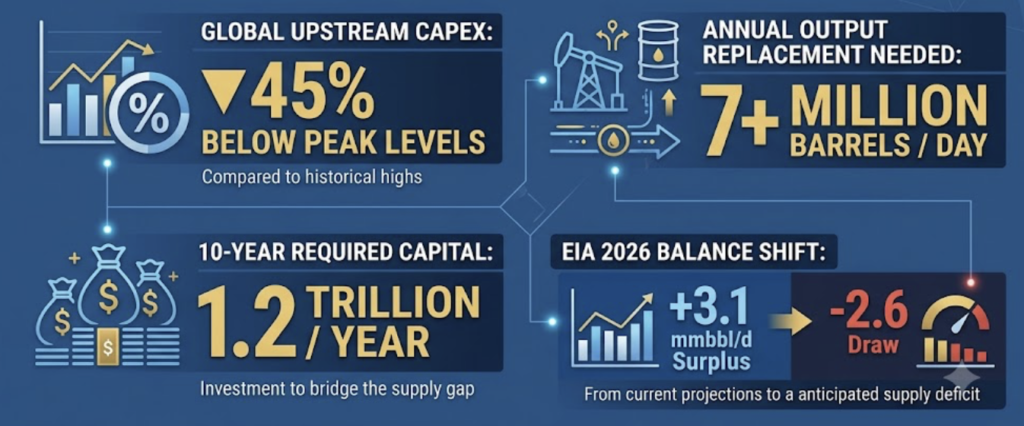
According to recent PitchBook data and market analysis, private equity sponsors and institutional capital allocators have initiated a massive, high-conviction buying spree in upstream oil and gas. Driven by a decade of systemic underinvestment, rapid natural decline rates in shale production, and geopolitical shocks—most notably the conflict in Iran, which abruptly swung the U.S. Energy Information Administration’s 2026 oil balance from a 3.1 million barrels per day (mmbbl/d) surplus into a 2.6 mmbbl/d draw—the energy paradigm has fundamentally shifted.
The market is no longer pricing energy purely on demand projections; it is paying a steep premium for supply security.
At DiedrichCo, we examine the macroeconomic forces driving this private equity resurgence, dissect the recent wave of billion-dollar basin consolidations, and outline how middle-market E&P founders, boards, and sponsors can capitalize on this unprecedented window of liquidity.
The Macro Paradox: $1.2 Trillion Gap Meets Public Capital Discipline
To understand why sponsor-backed capital is flooding the oil patch, management must look at the structural deficit that has accumulated over the past ten years. Global upstream capital expenditure remains approximately 45% below peak levels. Concurrently, the industry must replace more than 7 mmbbl/d of output annually merely to offset accelerating natural decline rates in mature shale plays. PitchBook estimates that the global oil and gas sector requires $1.2 trillion in annual investment over the next decade—a 20% to 30% increase in upstream capex to roughly $725 billion annually—to replenish depletion pipelines.
THE UPSTREAM CAPITAL SUPPLY GAP
Herein lies the structural opportunity for private capital: Public E&P producers remain constrained by public equity market mandates to maintain capital discipline, enforce strict dividend payouts, and limit aggressive organic drilling. Public markets penalize public issuers that deploy excessive balance sheet capital into unproven exploration.
This friction creates a critical operational vacuum. Private equity sponsors are stepping directly into this void—buying, building, and consolidating high-quality upstream assets in geopolitically insulated, export-capable North American jurisdictions.
Anatomy of the Buying Spree: High-Velocity Basin Consolidation
The momentum across key North American basins reflects both institutional sponsors scaling up platforms ahead of a prolonged supply deficit and legacy PE vehicles executing lucrative exits into public acquirers.
1. The Permian & Delaware Basins
- Matador Resources & Paloma Permian: Matador announced a $1.28 billion acquisition of EnCap Investments-backed Paloma Permian, expanding its high-margin footprint in the Delaware Basin.
- Verde Operating & VTX Energy: Carnelian Energy Capital and EnCap-backed Verde Operating acquired VTX Energy Partners’ South Delaware Basin assets from Vitol.
- Post Oak Energy Capital: Completed a rapid sequence of asset divestitures across the Southern Delaware (UpCurve Energy) and Permian (Midway Energy Partners).
2. Eagle Ford, Austin Chalk & Deepwater
- Magnolia Oil & Gas / WildFire Energy: Magnolia executed a $4.06 billion acquisition of WildFire Energy (backed by Warburg Pincus and Kayne Anderson), uniting complementary Eagle Ford and Austin Chalk footprints.
- Deepwater Gulf of Mexico: Talos Energy partnered with Riverstone-backed Ridgewood Energy to acquire deepwater US Gulf assets from Shell for $1.7 billion.
3. Canadian Thermal & Natural Gas
- Waterous Energy Fund / Greenfire: Greenfire Resources executed a $900 million acquisition of Connacher Oil and Gas, consolidating adjacent thermal oil sands assets in Alberta.
- Midstream & Asset Pipeline: Significant divestiture targets continue to hit the market—including Quantum Capital Group seeking over $3 billion for Bison Oil and Gas (DJ Basin), Greenbelt Capital exploring a $3 billion sale of TRP Energy (Permian), and Devon Energy weighing over $4 billion in non-core asset sales.
The DiedrichCo Strategic Perspective: Navigating the Liquidity Window
For middle-market operators and independent energy boards, this influx of private equity capital represents a rare, time-sensitive inflection point. Whether your enterprise is seeking a growth capital injection, executing a “buy-and-build” consolidation roll-up, or preparing for an exit into a public producer, success requires sophisticated capital architecture:
- Weaponizing Equity via Alternative Listings: As public E&P majors hunt for scale, private operators with $20M to $150M in EBITDA can command premium multiples by transitioning to public status via Reverse Takeovers (RTOs) or Direct Listings, converting illiquid private shares into a high-velocity acquisition currency.
- Pre-Diligence Asset Positioning: Buyers and sponsors are paying up for inventory duration, clean ESG compliance, and clear cash flow visibility. Structuring your financial disclosures and Quality of Earnings (QoE) to institutional specifications prior to entering the market prevents last-minute valuation haircuts.
- Optimizing Sponsor Alignment: Navigating the preference stack between single/multi-family office patient capital and traditional fixed-horizon private equity dictates your operational control post-transaction.
Architect Your Energy Transition Strategy
The supply-side crisis in global energy is not a temporary shock; it is a multi-year macroeconomic reality. Waiting for market conditions to shift is a passive posture—the capital is active, and the window for peak valuation is open.
At DiedrichCo, we serve as the definitive execution layer for middle-market leadership teams, boards, and institutional sponsors. We align complex corporate finance functions, de-risk M&A due diligence, and architect sovereign paths to liquidity that maximize enterprise value.