
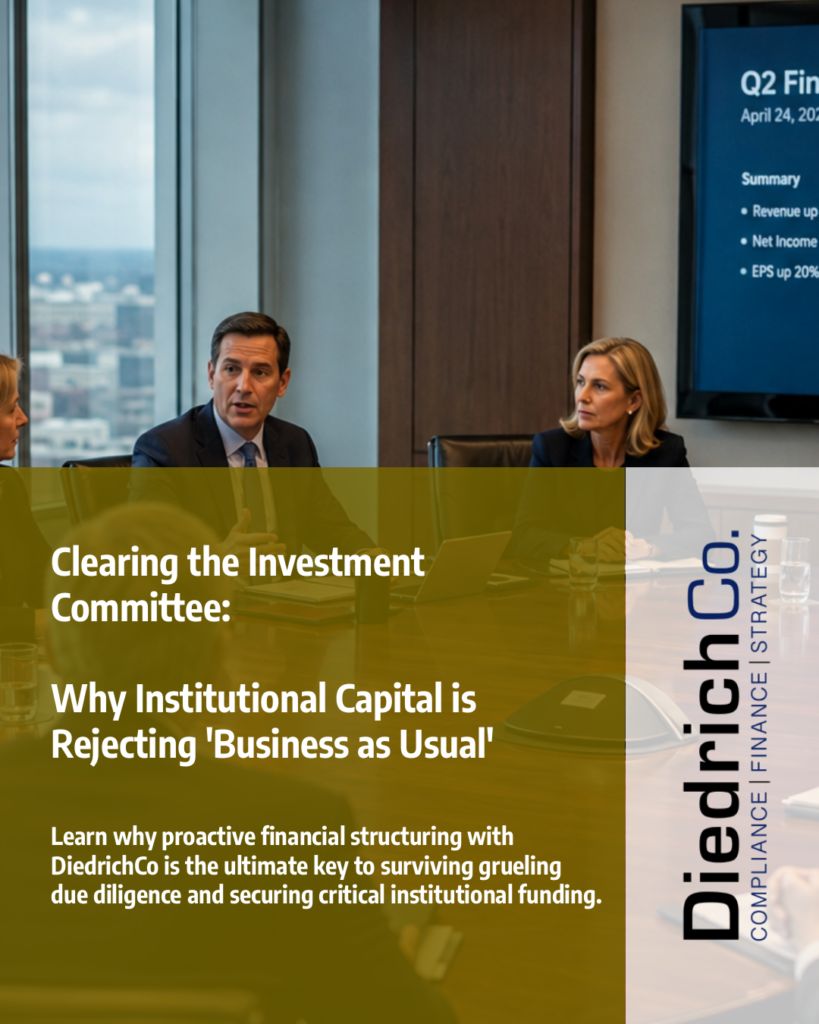
Clearing the Investment Committee: Why Institutional Capital is Rejecting ‘Business as Usual’
The private credit market has entered 2026 facing its most significant stress test in recent history. While headlines frequently fixate on the sheer volume of capital waiting on the sidelines—a nearly $1 trillion direct lending market in the U.S. alone—a severe disconnect has emerged between supply and deployment. For middle-market and emerging growth CEOs, the reality on the ground is stark: institutional investment committees (ICs) are increasingly rejecting capital requests.
Crucially, these rejections are rarely driven by fundamental market risk or a flawed core business model. Instead, they are the direct result of a friction point that is entirely preventable: sub-par financial reporting, opaque corporate governance, and a lack of institutional-grade data architecture.
Here is why “business as usual” is no longer sufficient to secure strategic capital, and how proactive structuring is the only way to survive the 2026 diligence crucible.
The 2026 Diligence Crucible
Following a wave of high-profile bankruptcies and rising default rates in late 2025, the financial media was quick to herald a crisis in private credit. While systemic contagion has not materialized, the psychological impact on asset managers has been profound. ICs are operating with heightened scrutiny, demanding pristine transparency before allocating a single dollar.
Compounding this caution is a lack of “workout bandwidth.” In 2026, lenders are devoting unprecedented time and resources to managing existing stressed portfolios, handling amendment negotiations, and navigating payment-in-kind (PIK) conversions. Consequently, ICs have zero tolerance for underwriting new deals that require extensive pre-close data remediation. If a company’s financial narrative is muddy, disjointed, or requires the lender to connect the dots, the deal is dead on arrival.
The End of ‘Business as Usual’
Many middle-market operators operate under a dangerous misconception: they believe that strong top-line revenue and a compelling product are enough to paper over messy accounting. In previous years, when capital was cheap and deployment mandates were aggressive, they might have been right.
Today, institutional capital requires a fundamentally different language. The International Monetary Fund recently noted that up to 40% of private credit borrowers suffer from negative free cash flow, leaving lenders hyper-vigilant regarding liquidity management. When an IC evaluates a middle-market firm, they are looking for:
- Defensible Pro Formas: Cash flow models that withstand aggressive downside stress-testing.
- Regulatory Readiness: Financials structured with the rigor of SEC compliance, even if the company is currently private.
- Audit-Ready Architecture: Clean, reconciled data rooms that eliminate the need for grueling forensic accounting during due diligence.
If a CEO presents an IC with financial statements that lack this architecture, it signals a deeper operational immaturity. It tells the institutional investor that the company is not ready to act as a fiduciary of complex capital.
The Translator’s Imperative: The DiedrichCo Solution
Bridging the gap between entrepreneurial reality and institutional expectation requires a specialized translator. This is where DiedrichCo serves as a critical advisor. Securing flexible capital or navigating an M&A liquidity event demands that a company’s internal reporting be elevated to Wall Street standards well before the pitch-book is ever opened.
We eliminate the frictions that kill deals in the committee room by implementing proactive, technical financial architecture:
- Pre-Audit Data Cleansing: We systematically sanitize historical financials, resolving discrepancies and aligning accounting policies with GAAP and PCAOB standards. This ensures that when the buy-side diligence team arrives, the data is bulletproof.
- Institutional-Grade Pro Forma Modeling: We build the sophisticated, dynamic financial models that ICs require to validate enterprise value and assess downside protection.
- EDGAR & iXBRL Architecture: For companies targeting the public markets, we implement the technical reporting tags required by the SEC. Even for private companies, adopting this level of reporting rigor signals a profound commitment to governance that drastically reduces the perceived risk premium.
The Window is Open for the Prepared
The capital is out there. Pension funds, insurers, and private wealth channels continue to pour billions into private credit and capital solutions funds. However, the bar for entry has been permanently raised.
In 2026, securing strategic capital is no longer a matter of simply having a good business; it is a matter of proving it through uncompromising financial transparency. By partnering with technical experts to build an institutional-grade reporting architecture, emerging growth CEOs can bypass the exit bottleneck, clear the investment committee with confidence, and secure the capital necessary to define the next era of their industry.