
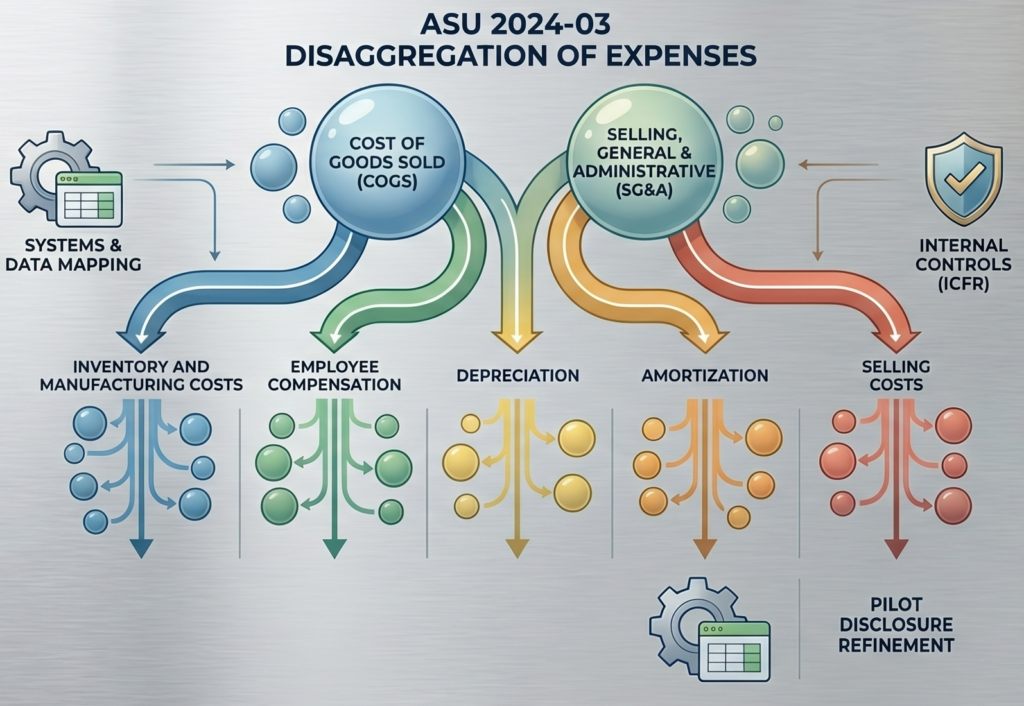
The “Big Five”: Understanding the Core Requirements
ASU 2024-03 requires public companies to pull back the curtain on aggregated expense lines. Investors will no longer see “black box” figures for SG&A or COGS. Instead, these must be broken down into five mandatory categories:
- Inventory and Manufacturing Costs: Vital for assessing supply chain efficiency.
- Employee Compensation: Breaking out payroll from functional silos like R&D.
- Depreciation: Highlighting capital investment lifecycles.
- Amortization: Clarifying the impact of intangible assets.
- Selling Costs: Measuring the true cost of customer acquisition.
The Implementation Challenge: Why Systems May Fail
The theory is simple, but the execution is where many teams struggle. To be transaction-ready, your data must be agile.
- Data Mapping: Can your ERP automatically isolate “Employee Compensation” from within a “Research & Development” bucket? If your process relies on manual spreadsheets, your audit risk just skyrocketed.
- Internal Controls (ICFR): Management must document exactly how these figures are aggregated. These are now subject to the same rigor as your primary financial statements.
- The Quarterly Pressure: These disclosures aren’t just for the annual 10-K; they are required for interim reporting. This adds significant weight to the quarterly close process.
3 Steps to Ensure Transaction Readiness
Diedrich Consulting recommends a proactive approach to prevent reporting delays:
- Perform a Gap Analysis: Map your current Chart of Accounts (COA) against the new requirements to see what is currently “hidden.”
- Stakeholder Alignment: Bridge the gap between HR (compensation data) and Procurement (inventory) to automate data feeds.
- Run a Pilot Disclosure: Draft a “mock” income statement using current data. This reveals exactly where your data clarity breaks down before the SEC is watching.
Final Thoughts
ASU 2024-03 is more than a compliance hurdle; it’s an opportunity to refine your financial storytelling. By mastering these disclosures early, finance teams provide the transparency investors demand while strengthening their own internal data integrity.
Does your team have a transition roadmap? At Diedrich Consulting, we specialize in M&A advisory and transaction readiness. Contact us today to ensure your disclosures meet the new standard of excellence.