SPAC & De-SPAC Transaction Advisory.
Accelerating Public Entry. Securing Institutional Alignment. De-risking the De-SPAC Lifecycle.
The Strategic Realities of the De-SPAC Alternative
For high-growth, mid-market enterprises, the traditional IPO is often a slow, rigid process. It subjects your company to unpredictable market “windows,” banking syndicate underpricing (the classic IPO “pop” that leaves money on the table), and strict prohibitions against marketing future growth projections.
A business combination with a Special Purpose Acquisition Company (SPAC) turns this traditional dynamic on its head. Instead of pitching a shifting syndicate of public fund managers, you negotiate your valuation directly with the SPAC sponsor team. This changes your route to the public market from a generic fundraising exercise into a structured corporate merger, giving you much more control over your valuation premium.
Key Tactical Drivers:
Why Sophisticated Boards Choose SPACs
According to institutional deal studies by KPMG and Schroders, a De-SPAC transaction offers private companies three distinct advantages that traditional listings cannot match:
1. Forward-Looking Valuation Flexibility
The Safe Harbor EdgeIn a traditional S-1 IPO prospectus, you are legally restricted to showing only historical financial data. This puts complex, fast-growing disruptors at a disadvantage. Because a De-SPAC transaction is legally structured as a merger, it benefits from M&A Safe Harbor provisions. This allows your enterprise to share multi-year forward financial projections directly with PIPE (Private Investment in Public Equity) investors and public markets, ensuring your future growth potential is fully factored into your day-one valuation.
2. Upfront Price Certainty in Volatile Markets
Clarity Where It CountsIn a traditional IPO, your final share price is not locked in until the night before your public debut, leaving you exposed to sudden market shifts. With a SPAC, your valuation is contractually fixed when you sign the Definitive Agreement. This eliminates market-timing risks and ensures macro volatility won’t disrupt your transaction.
3. Near Immediate Capital Access
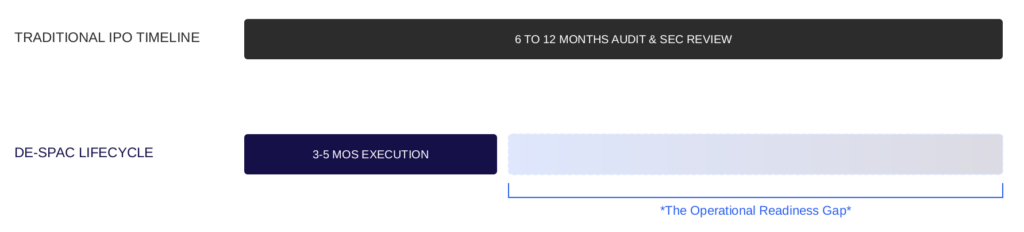
When Time MattersThe Benchmark: Data from DFIN (Donnelley Financial Solutions) shows that a traditional IPO takes 6 to 12 months of formal preparation and SEC review cycles, this prior to underwriting.
This is what give you the SPAC Edge: A structured De-SPAC transaction can close in as little as 3 to 5 months from signing a Letter of Intent (LOI). This cuts your timeline to public market liquidity by more than half, allowing you to move fast in consolidating industries where timing is critical.
The Operational Reality:
Bridging the “Public Readiness” Gap
While the speed of a SPAC is a major advantage, it also introduces a serious challenge: the compressed public company readiness timeline. In a traditional IPO, you have up to a year to build out your internal controls, investor relations teams, and financial reporting systems. In a De-SPAC transaction, your private operating enterprise must be fully ready to operate as an SEC-compliant public company in less than 120 days.
This is exactly where DiedrichCo serves as your strategic execution layer. While the SPAC sponsor drives their investment thesis and the investment bank structures the PIPE backstop, we focus entirely on preparing your business for day-one public trading. We help your management team cross the finish line without stalling your daily business operations.