
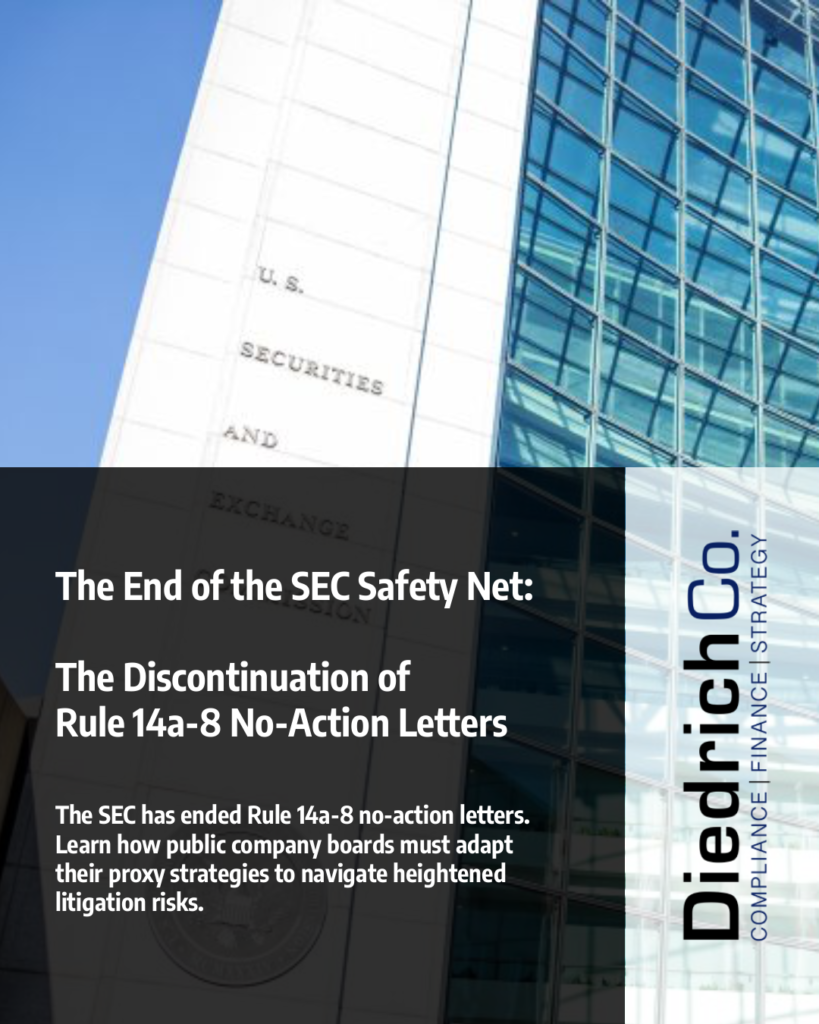
On August 14, 2026, the SEC’s Division of Corporation Finance announced a fundamental shift in proxy season mechanics: it will no longer respond to any no-action requests under Exchange Act Rule 14a-8.
For decades, public companies seeking to exclude shareholder proposals from their proxy materials relied on the SEC’s no-action process as a critical safety net. By securing staff concurrence that a proposal could be omitted, companies minimized their litigation risk and gained regulatory cover.
That cover is now gone. Effective immediately, the decision to exclude a shareholder proposal rests entirely squarely on the shoulders of company management, boards, and outside counsel.
Here is what public companies need to understand about this policy shift—and how to adapt your proxy strategy moving forward.
How We Got Here
Under Rule 14a-8, public companies must include a shareholder’s proposal in their proxy materials unless it falls under one of thirteen specific exclusion bases. Historically, companies filed “no-action requests” 80 days before filing their definitive proxy statements, asking the SEC staff to confirm they wouldn’t recommend enforcement if the proposal was omitted.
The SEC began stepping back from this process in November 2025, when it cited resource constraints and transitioned to a “no objection” letter process that offered no evaluation of the merits.
The August 2026 announcement is the final culmination of that pullback. The SEC’s shareholder proposal email address has been deactivated, and the Division will no longer issue responses of any kind, including for proposals deemed improper under state law. The SEC has stated it is redirecting these resources to statutorily required reviews to protect investors and facilitate capital formation.
The Immediate Implications
While the SEC’s procedural requirements remain unchanged—companies must still submit their reasons for exclusion 80 days in advance via the online Shareholder Proposal Form—the strategic landscape has shifted dramatically.
- Heightened Litigation Risk: Without the shield of an SEC staff response, exclusion decisions are now vulnerable to direct legal challenges by shareholders. The numbers already reflect this new reality: the 2025–2026 proxy season saw six lawsuits filed by proponents challenging exclusions, compared to fewer than 30 such lawsuits in the previous fifty years combined.
- The Burden on Counsel: The responsibility for interpreting the SEC’s vast library of published no-action letters and judicial precedent now falls entirely on internal and outside legal teams.
- Increased Shareholder Scrutiny: Institutional investor groups are highly mobilized. Campaigns like “Protect Shareholder Voice” signal that ESG-focused shareholders and activist organizations are prepared to push back aggressively against exclusions they view as unjustified.
Action Plan for Boards and Management
With the regulatory backstop removed, public companies must adopt a more rigorous and potentially more conservative approach to proxy season.
1. Bulletproof Your Documentation Every exclusion decision must be exhaustively analyzed against the thirteen bases in Rule 14a-8(i), judicial precedent, and historical SEC guidance. Ensure this analysis is thoroughly documented and reviewed at the board level before any final decision is made.
2. Weigh Proponent Resources in Your Risk Modeling Well-resourced proponents—such as public pension funds, union retirement systems, and activist organizations—have already demonstrated their willingness to litigate. When evaluating whether to exclude a proposal, explicitly factor the proponent’s sophistication and financial backing into your legal and reputational risk assessments.
3. Shift to Early Engagement Given the spike in litigation risks, outright exclusion is now a high-stakes maneuver. Companies should strongly consider prioritizing early, proactive engagement with proponents. Negotiating a withdrawal or agreeing to a modified proposal is often vastly more cost-effective and less disruptive than defending an exclusion in federal court.
4. Adopt a Conservative Default Posture In areas where historical SEC guidance is contradictory, thin, or outdated, tread carefully. During the 2025–2026 season, approximately 80% of company submissions cited only a single exclusion ground—a significant shift from prior years when companies threw multiple arguments at the wall. Moving forward, precision and legal conservatism will serve companies better than aggressive exclusion tactics.
Looking Ahead
While the SEC noted that this discontinuation is effective “unless and until the Division announces otherwise,” a return to the old no-action process seems unlikely. The SEC’s regulatory agenda includes “Shareholder Proposal Modernization,” suggesting that sweeping reforms—or potentially a complete rescission of federal procedural requirements surrounding Rule 14a-8—could be on the horizon.
Until then, the message for public companies is clear: prepare for a more adversarial proxy season, invest in early shareholder engagement, and ensure your legal rationale for any exclusion is prepared to withstand a courtroom stress test.
Secure Your Regulatory Standing
The SEC’s evolving rules mean that maintaining compliance is no longer just a legal checkbox—it is a critical corporate strategy. Diedrich Consulting specializes in SEC compliance, corporate governance, and transaction readiness for middle-market issuers.
Whether you are navigating proxy season vulnerabilities, structuring capital formation, or ensuring your board remains insulated from regulatory and litigation risks, our advisory team provides the specialized insight needed to defend your operations.
Do not leave your compliance to chance in an adversarial regulatory environment, reach out to #DiedrichCo today to fortify your proxy strategy and maintain seamless standing with regulators.